
Climate change is the greatest threat to humanity
Climate change is the greatest threat to human health, accelerated by activities such as burning fossil fuels. This releases greenhouse gases that trap the sun’s heat.
The average temperature of the Earth’s surface is already 1.2 °C higher than it was in the late 19th century, and it is projected to more than double by the end of this century.

The consequences of climate change include droughts, water shortages, wildfires, melting glaciers, catastrophic storms, and declining biodiversity.
The internet is a significant part of the problem
Shockingly, the internet is responsible for more global greenhouse gas emissions than the aviation industry, and it is projected to account for 14% of all global greenhouse gas emissions by 2040.
If the internet were a country, it would be the fourth-largest polluter in the world and the largest coal-powered machine on the planet.
But how can something digital, like the internet, produce harmful emissions?
Internet emissions come from the energy required to power the infrastructure that keeps the internet running, such as huge data centres and data transmission networks, which consume enormous amounts of electricity.
Internet emissions also come from the production, distribution, and use of the roughly 30.5 billion devices — phones, laptops, and others — that we use to connect to the internet.
It is no surprise that internet-related emissions are increasing, considering that
We urgently need to reduce the internet’s environmental impact
As responsible digital professionals, we must act quickly to reduce the environmental impact of our work.
It is encouraging to see the UK government promoting action by adding “Reduce environmental impact” to its good practice design principles, but our industry still has too much talk and too little corrective action.

The reality of many tightly constrained, fast-paced, commercially driven web projects is that reducing environmental impact is far from the top of the agenda.
So how can we give the environment a higher priority and talk about it in a way that stakeholders will actually listen to?
A recent “eureka” moment during a webpage optimisation project gave us an idea.
Our “eureka” moment
Our work to reduce page weight focused purely on technical changes carried out by our developer based on recommendations from tools such as Google Lighthouse. This reduced the size of webpages in the main user journey by up to 80%. As a result, pages downloaded up to 30% faster, and the carbon footprint of the journey fell by 80%.
We had not set out to reduce the carbon footprint, but seeing these results was our “eureka” moment.
We realised that by reducing page weight, you improve performance — which is a win for users and service owners — while also using less energy, because less data needs to be transferred and stored. This creates an additional benefit for the planet. Everyone wins.
This felt like a breakthrough, because business, user, and environmental requirements often appear to be in conflict. Focusing on simplifying websites so they are as simple, lightweight, and easy to use as possible creates benefits that go beyond the triple bottom line — people, planet, and profit — and also include performance and purpose.
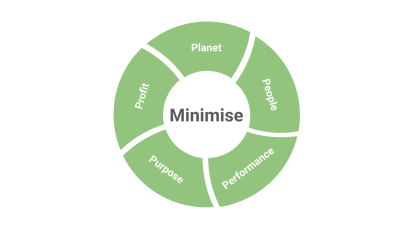
So why is “minimisation” such a strong digital sustainability strategy?
- Profit. Website providers win because their website becomes more efficient and more likely to achieve its intended goals. A lighter website should also lead to lower hosting costs.
- People. People win because they can use a website that downloads faster, feels quicker, and is easier to use, because it has been deliberately designed to be as simple as possible, allowing them to complete their tasks with minimal effort and mental energy.
- Performance. Lightweight webpages download faster, so they perform better for users, especially those using older devices and slower network connections.
- Planet. The planet wins because less energy, and therefore fewer associated emissions, is required to deliver the website.
- Purpose. We know we do our best work when we feel a sense of purpose. Being a digital professional and knowing that our work is doing good in the world and contributing to better outcomes for people and the environment is deeply satisfying.
To prioritise the environment, we need to be able to speak confidently in a language that resonates with business and ensure that any investment of time and resources creates the greatest possible benefit.
So even if you feel that the environment is a very low priority in your projects, focusing on reducing page weight to improve performance — which is usually high on the agenda — is a great Trojan horse for the environmental agenda, if one is needed.
Doing the right thing is not always easy, but we have done it before when we managed to prioritise issues such as usability, accessibility, and inclusion in digital projects.
Many of the things that make websites easier to use, more accessible, and more efficient also help reduce their environmental impact. That means the actions you need to take will feel familiar and achievable, so do not worry that you will need to learn something completely new.
In theory, all of this makes sense. But what is the masterplan we should apply in practice?
The masterplan
The masterplan for creating websites with minimal environmental impact is to focus on delivering maximum value with minimal energy input.
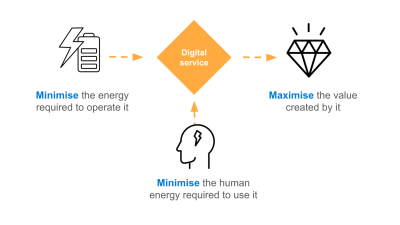
This is an adaptation of Buckminster Fuller’s “Dymaxion” principle — one of his many progressive and innovative sustainability strategies for living and surviving on a planet with limited resources.
Energy input includes both the electrical energy required to run websites and the mental energy required to use them.
You can achieve this by minimising websites down to their essential content, features, and functionality, ensuring that everything is justified by its ability to meet a business or user need. This means that anything that does not create proportionate value compared with the energy required to provide it should be removed.
So that is the masterplan. But how do we put it into practice?
Decarbonise your most valuable user journeys
We have created a new method called “User Journey Decarbonisation” to help you reduce your website’s environmental impact and maximise its performance.
Note: The method intentionally focuses on optimising key user journeys rather than whole websites, to keep things manageable and make it easier to get started.
The secret is to start small, demonstrate improvements, and then scale up.
The method consists of five simple steps:
- Identify your most valuable user journey.
- Benchmark your user journey.
- Set targets.
- Decarbonise your user journey.
- Monitor and share your progress.
Here is how it works.
Step 1: Identify your most valuable user journey
Your most valuable user journey might be the one your users value most, the one that generates the most revenue, or the one that is essential to your organisation’s success.
You can also focus on a user journey that you know performs particularly poorly and has the potential to deliver significant business and user benefits if improved.
You may have many important user journeys, and there is nothing wrong with decarbonising several journeys at the same time if you have the resources. But we recommend starting with one to keep things simple.
To make this clearer, let’s consider a hypothetical example: a top-tier football club trying to decarbonise its online ticket-buying journey, which receives high traffic and is responsible for a large share of weekly revenue.
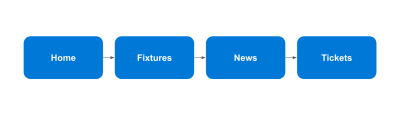
Step 2: Benchmark your user journey
Once you have selected a user journey, you need to benchmark it by assessing how well it meets user needs, how much value it provides to your organisation, and what its carbon footprint is.
It is essential to understand what job the journey needs to do and how well it does that job before you start decarbonising it. There is no point removing parts of the journey to reduce its carbon footprint, for example, if you damage its ability to meet a core user or business need.
You can assess how well your user journey meets user needs by conducting user research and analysing existing customer feedback. Interviews with business stakeholders will help you understand what value your journey provides to the organisation and how well business needs are being met.
You can assess the carbon footprint and performance of your user journey using online tools such as Cardamon, Ecograder, Website Carbon Calculator, Google Lighthouse, and Bioscore. Make sure you have your analytics data available to get the most accurate footprint estimate possible.
To use these tools, simply enter the URL of each page in your journey, and they will provide a range of information, such as page weight, energy rating, and carbon emissions. Google Lighthouse works slightly differently through a browser extension and generates a very useful and detailed performance report rather than a carbon rating.
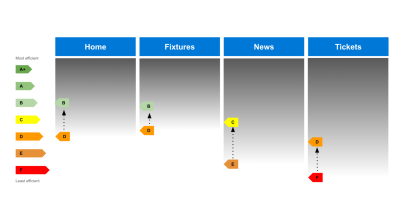
A great way to bring your benchmarking results to life is to visualise them in a similar way to how you would present a customer journey map or service blueprint.
This example focuses only on communicating the carbon footprint of a user journey, but you can also add more rows to show how well the journey performs from a user and business perspective, including user pain points, quotes, and business metrics where relevant.
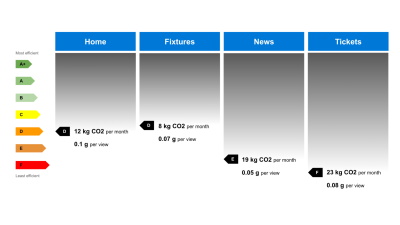
We have found that adding energy efficiency ratings is highly effective, because it is a method people recognise from household appliances. It provides useful context compared with simply showing CO2 weight, such as grams or kilograms, which usually means very little to people.
We also include a benchmarking dataset for each page in the user journey in our benchmarking reports. This gives stakeholders a more detailed breakdown and a simple summary alongside a snapshot of the assessed page.
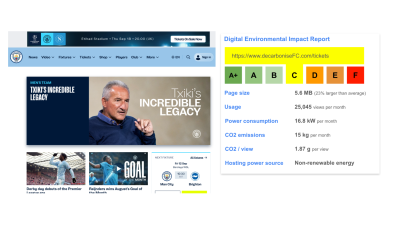
Your benchmarking activity will give you a very clear picture of where corrective work is needed from an environmental, user, and business perspective.
In our football user journey example, it is clear that the “News” and “Tickets” pages need attention to reduce their carbon footprint, so they would be a sensible priority for decarbonisation.
Step 3: Set targets
Use your benchmarking results to set targets to work towards, such as a carbon budget, energy efficiency rating, maximum page weight, and minimum Google Lighthouse performance targets for each individual page, in addition to your existing UX metrics and business KPIs.
There is no right or wrong way to set targets. Choose what you believe is achievable and viable for your business. You will only find out how realistic and attainable they are once you start decarbonising your user journeys.
Setting targets is important because it gives you something to aim for and keeps you focused and accountable. The quantitative nature of this work is excellent because it allows you to quickly demonstrate the positive impact of your work, making it easier to justify the time and resources invested in it.
Step 4: Decarbonise your user journey
Your goal now is to decarbonise the user journey by reducing page weight, improving the Lighthouse performance score, and minimising pages so that they meet both user and business needs in the most efficient, simple, and effective way possible.
How you do this depends on the resources and skills available to you. You might focus on specific pages or address a particular problem area, such as large images or videos across the whole user journey.
Here is a list of activities that will help reduce the carbon footprint of your user journey:
- Review the recommendations in the “diagnostics” section of your Google Lighthouse report to optimise page performance.
- Switch to a green hosting provider if you are not already using one. The Green Web Directory can help you choose one.
- Review the W3C Web Sustainability Guidelines, implementing the most relevant guidance for your specific user journey.
- Remove anything that provides no user or business value.
- Reduce the amount of information on your webpages so they are easier to read and less tiring for people.
- Replace content with a lighter alternative, such as replacing video with text, if the lighter alternative provides the same value.
- Optimise assets such as images, videos, and code to reduce file sizes.
- Remove any barriers that prevent access to your website and any distractions that get in the way.
- Reuse familiar components and design patterns so your websites are quicker and easier to use.
- Write simply and clearly, using plain language, to help people get the most value from your website and avoid mistakes that waste time and energy to resolve.
- Fix any usability issues identified during benchmarking to ensure your website is as easy to use and as useful as possible.
- Ensure that your user journey is as accessible as possible, so it can be used by the widest possible audience and offset the environmental cost of providing the website.
Step 5: Monitor and share your progress
As you decarbonise your user journeys, use the benchmarking tools from Step 2 to monitor your progress against the targets you set in Step 3, and share your progress as part of wider sustainability reporting initiatives.
If all goes well, at this stage you will have numbers showing how your user journey’s performance has improved and how much you have reduced its carbon footprint.
Share these results with the business as soon as you have them, so you can secure the resources needed to continue the work and start similar work on other high-value user journeys.
You should also start communicating your progress to users.
It is important that they are informed about the carbon footprint of their digital activity and can make informed decisions about the environmental impact of the websites they use.
Ideally, every website should communicate the emissions generated by viewing its pages to help people make these informed decisions and encourage website providers to minimise their emissions if they are displayed publicly.
Often, people will have no choice but to use a specific website to complete a particular task, so it is the website provider’s responsibility to ensure that the environmental impact of using their site is as low as possible.
You can also help raise awareness of websites’ environmental impact and what you are doing to reduce your own by publishing a digital sustainability statement, such as Unilever’s, shown below.
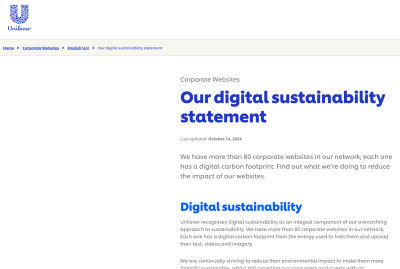
A good digital sustainability statement should acknowledge your website’s environmental impact, what you have done to reduce it, and what you plan to do next to reduce it further.
As an industry, we should normalise publishing digital sustainability statements in the same way that accessibility statements have become a standard addition to website footers.
Useful decarbonisation principles
Keep the following principles in mind to help decarbonise your user journeys:
- Do more and talk less. Start decarbonising your user journeys as soon as possible to accelerate learning and positive change.
- Start small. Starting small by decarbonising an individual journey makes it easier to begin and faster to get results that demonstrate value.
- Aim to do more with less. Minimise what you offer to ensure maximum value for the energy consumed.
- Make your website as useful and easy to use as possible. Useful websites can justify the energy they consume by ensuring they are net positive — doing more good than harm.
- Focus on progress, not perfection. Websites are never finished or perfect, but they can always be improved. Every small improvement makes a difference.
Start decarbonising your user journeys today
User journey decarbonisation should not be a one-off action carried out only the next time you decide to redesign or replatform your website. It should happen continuously as part of a wider digital sustainability strategy.
We know that websites are never finished and that the best websites keep improving as both user and business needs change. We would encourage people to adopt the same mindset when it comes to minimising the environmental impact of their websites.
Decarbonisation will be most effective when digital professionals challenge themselves every day to “minimise” whatever they are working on.
This helps avoid accumulating “carbon debt”, made up of the growing technical and design debt in our websites, which is always harder to remove retrospectively than to prevent in the first place.
By taking a pragmatic approach, such as optimising high-value user journeys and connecting that work to business metrics like performance, we have the best possible chance of making digital sustainability a priority.
You have probably noticed that, apart from using website carbon calculators, this method does not require any skills that typical digital teams do not already have. That is great, because it means you already have the skills required to do this important work.
We would encourage everyone to raise the environmental impact of the internet in their next team meeting and try this decarbonisation method to create better outcomes for people, profit, performance, purpose, and the planet.
Good luck!



.webp)
.webp)
.webp)
.webp)
.webp)