
What do the Suez Canal, the Roman goddess Libertas, and ancient Egyptian sculptures have in common? The Statue of Liberty.
Surprised? Of course — but the connections make sense once you know the story that Columbia University psychologist Sheena Iyengar shared in a recent episode of “Hidden Brain.”
French artist Frédéric Bartholdi drew inspiration from Egyptian sculptures when he submitted a design for a sculpture that was meant to be built near the Suez Canal.
That plan for the Suez Canal sculpture fell through, so Bartholdi and his friend began raising funds to create a sculpture as a gift to the United States. Bartholdi designed the sculpture after studying the subtleties of the Roman goddess Libertas, an important female icon in the late 19th century. He also modeled the statue after Isabelle Boyer, who was 36 years old in 1878. Finally, Bartholdi incorporated his mother’s face into the proposed design. The result? The Statue of Liberty.
Bartholdi’s unconventional yet methodical approach produced one of the most famous sculptures in the world.
How did he do it? Did he let his mind wander freely? Did he generate endless lists or sketch hundreds of plans for each sculpture? Was he a 19th-century advocate of brainstorming?
The problem
“Yes,” many of today’s innovation experts would answer. From morning standups to workshops, and from templates to whiteboards, unleashing creative juices often involves brainstorming along with reminders that “there are no bad ideas” and “the more ideas, the better.” This approach to creativity is practiced and repeated so often that it should work, right?
Wrong, says Iyengar. Too many ideas hinder creativity because the human brain can manage only a few ideas at once.
“Creativity requires having a lot of pieces and not only being able to hold them in your memory bank so that you can say what they are, but also being able to constantly manipulate them in different ways. And that means, you know, that for your mind to be flexible enough to do that, it will need fewer pieces.”
— “Hidden Brain,” “How to Be More Creative”
This view is also supported by research published by Anne-Laure Sellier of HEC Paris and Darren W. Dahl of the University of British Columbia. The authors compared knitting and craft-making in two experimental studies. The results showed that limiting the number of materials and other creative resources increased participants’ creativity. The reason was that participants were able to enjoy the creative process more, which improved their creative output.
A few years ago, we had a similar experience while planning a series of research studies. As with any initiative, defining scope was critical. The problem? Instead of choosing from two or three clearly defined options, the team discussed several topics at once, then added a flood of ideas about the best format for presenting those topics: lists, tables, charts, images, and diagrams. The results looked something like this.
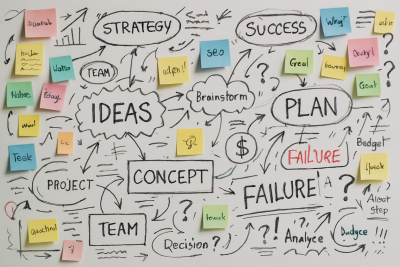
A messy whiteboard is not bad in itself. The question is whether brainstorming results like the board above block or encourage creativity. If the whiteboard above feels overwhelming, it is worth considering a more structured process for creativity and ideation.
The solution: three ways to strengthen creativity
Just as Bartholdi approached his designs methodically, today’s designers can benefit from constraints and structure.
In this article, we will highlight three methods that strengthen creativity:
- Guided curiosity
- Setting constraints and making a plan
- Looking into other fields
Tip 1: Guided curiosity
In today’s world, it is easy to fall into the trap of believing that creativity comes from simply immersing yourself in a flood of information — endlessly scrolling, consuming random facts, and filling your mind with unrelated data points. This is a trap, because mindless information intake without understanding the purpose or deeper context will not make you more creative.
Real creativity is fueled by curiosity — the desire to know more. Curiosity is powerful because it acts as an internal compass, guiding our search for knowledge with purpose.
When you are curious, you do not merely receive information passively; you actively seek it with purpose.
You have a question in mind, a direction, a reason that shapes the way you explore. This sense of purpose turns information from a chaotic influx of data into structured, meaningful insights that the brain can organize, categorize, and retrieve when needed.
In our role as user experience (UX) researchers, we recently had to review more than 100 internal and industry research articles to identify and understand what was already known about a specific topic. The challenge was how to sort, organize, and absorb this information without feeling overwhelmed. Would it be better to use AI tools such as Gemini or ChatGPT to summarize this body of knowledge? How reliable would those summaries be? Would it be better to read the summaries and copy a few themes to include in an overview of all these articles? What was the best way to organize this information? Which tool should we use for summarizing and organizing?
Facing a tight deadline and growing stress, we paused to rethink. To avoid getting lost, we asked: What are the main goals of this research review? Then we defined three core goals:
- Extract three to five themes to present to several internal teams.
- Create a research plan connected to those themes.
- Use those themes to create a series of screens that the design team would build for testing with real users.
Once we clearly defined the goals, we had a purpose. That purpose allowed us to direct our natural curiosity, because we knew why we were working through so much material and who would read and review the synthesis. Curiosity drove us to explore this large body of research, but purpose kept us focused.
Curiosity is the desire to learn more. Creativity requires curiosity, because without this desire, designers and researchers are less likely to explore new ideas or new ways of solving problems. The good news is that research and design attract naturally curious people.
The key is to turn curiosity into focused exploration. It is less about the amount of information absorbed and more about the purpose of the inquiry, the depth of engagement, and the strategic application of the knowledge gained.
Purposeful curiosity is the difference between drowning in a sea of knowledge and navigating it skillfully.
Tip 2: Setting constraints and making a plan
Just as purpose helps focus attention, constraints contribute to creativity. Generating 50 ideas may feel creative, but it can actually be more distracting than inspiring. Limiting the number of ideas is more productive.
“Some people think constraints mean they can’t be creative. Research shows that people are more creative when there are constraints.”
— Dr. Susan Weinschenk, “The Role of Creativity in Design”
The point is not to limit creativity and innovation, but to nurture them with structure. Setting constraints strengthens creativity by focusing ideation around a few core themes.
Here are two ways to focus ideation:
- During meetings and workshops, “How might we” (HMW) statements help focus discussion while still leaving room for a range of ideas. For example, “How might we shorten this 15-step workflow without omitting essential information?”
- Define the problem and run two exercises to test solutions. For example, three customer surveys conducted over the past six months show a consistent pattern: 30% of customers are dissatisfied with their call center experience, and call duration has increased over the same six-month period. Divide the team into two groups.
- Group 1 writes two new greeting versions for customer service representatives (CSRs) to use when a customer calls. The next step is an A/B test.
- Group 2 identifies two steps to remove from the current CSR script. The next step is a pilot period with CSRs to record call duration and customer satisfaction with the call.
“Constraint” can sound negative, like a restriction or limit, but it can also mean demonstrating control and restraint.
By practicing restraint, you and your team can develop higher-quality ideas and focus on solutions. Instead of generating 50 ideas for redesigning the entire call center setup, it is more productive to focus on two metrics: task completion time and the customer’s self-rated satisfaction after contacting the call center.
By directing this concentrated energy toward well-defined challenges, your team can efficiently pursue innovative solutions to two closely related problems.
Tip 3: Looking into other fields
Other fields or subject areas can be a valuable source of innovative solutions. When facing a complex design problem, limiting ideas while looking beyond the immediate domain is a powerful combination.
The high-risk field of airplane design provides a useful case study in limiting ideas and looking to other areas for solutions at the same time. Did you know that Otto Lilienthal, a 19th-century design engineer, was the first person to make repeated, successful flights with gliders?
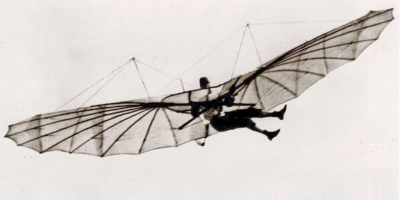
Maybe not, but you have probably heard of the Wright brothers, whose work launched modern aviation. Why? Lilienthal’s work, although essential, relied on a design based on bird wings, requiring the person operating the glider to move their entire body to change direction. This design eventually proved fatal when Lilienthal could not recover from a dive and crashed.
The Wright brothers were bicycle mechanics who used their knowledge of balance to create a control mechanism for pilots. By looking for solutions outside the “flight domain,” the Wright brothers found a way to balance and control airplanes and ultimately transformed aviation.
Similarly, Bartholdi, the French artist who created the Statue of Liberty, did not limit himself to reviewing statues in Paris. He traveled to Egypt, studied coins and paintings, and drew inspiration from his mother’s face.
Designers looking for inspiration should step away from the screen to paint, write a poem, or build a sculpture from popsicle sticks. In other words, paint with oils instead of pixels; write with ink instead of a keyboard; sculpt with sticks instead of empty space.
At first glance, seeking inspiration from other disciplines might seem to contradict Tip 2 — setting constraints. But from another perspective, setting constraints and exploring other fields are complementary methods.
Instead of writing ten random ideas on a board, it is more productive to focus on a few solutions and think through those solutions from different angles. For example, we recently faced a large volume of ideas, source material, and diagrams. Although organizing this information was possible, condensing it into a form that others could absorb proved challenging.
Rather than generating a list of ten ways to shorten the information, we took the dog for a walk and let our eyes wander through the park. What did we see when our eyes drifted toward the bare trees? Branches. And what do diagrams do? They branch in different directions.
After finishing the walk, we returned to the computer and began organizing the source material into a series of branching flows. Was it wildly innovative? No. Was it the first time we had drawn diagrams with branches? Also no. The difference in this case was applying the branching solution to all of our source material, not only to diagrams. In short, a walk and a nudge from nature’s design helped us break out of the constraints imposed by the two-dimensional screen.
Stepping away from the screen is, of course, good for our mental and physical health. The occasional lightbulb moment is a bonus we gladly accept.
Conclusion
But those moments alone are not enough. You need to direct inspiration by applying practical methods to move forward with design and analysis; otherwise, you will be overwhelmed by so many ideas that you become paralyzed and unable to decide.
To avoid paralysis and reduce the likelihood of wasted time, we have argued against brainstorms, endless lists, and wall-to-wall sticky notes. Instead, we have suggested three practical methods for encouraging creativity.
- Guided curiosity. From brainstorms to endless scrolling, immersing yourself in large amounts of information is a trap, because absorbing information without understanding the purpose or deeper context will not make you more creative. The solution lies in turning curiosity into focused exploration. Purposeful curiosity allows you to explore, think, and identify solutions without drowning in a sea of information.
- Setting constraints. Generating long lists of ideas may feel creative, but it can actually be more distracting than inspiring. The solution is to nurture creativity with structure by limiting the number of ideas under consideration. This structure strengthens creativity by focusing ideation around a few core themes.
- Looking beyond the immediate field. Otto Lilienthal’s fatal glider crash shows what can happen when solutions are examined only through the lens of one field. The solution is to focus on innovative responses to one problem while thinking about that problem from several perspectives, such as two-dimensional design, three-dimensional design, or nature’s design.
Resources
- “How to Be More Creative”, Hidden Brain Media
- [suspicious link removed], Anne-Laure Sellier and Darren W. Dahl



.webp)
.webp)
.webp)
.webp)
.webp)